 |
 Grass
Snake
Grass
Snake

(Natrix
natrix natrix, N.n.persa)
Aesculapian
Snake
Grass
Snake
Smooth
Snake
Nose-horned
Viper
Common European Viper
|
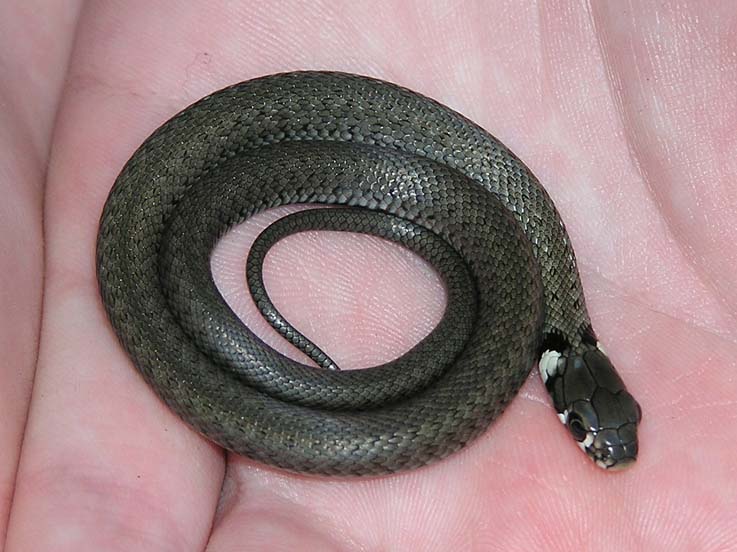
Averages 150 cm in length, but can reach arround 200 cm (N. n. helvetica), females are bigger than males (fatter, up to 2x longer!). Adults have a round head, round pupils. Colour varies (black-blue-dark grey, brown, olive grey, can have black dots, sometimes light stripes...), but a lot have 2 white/orange/yellow spots (sometimes black) behind head. Young can be confused with baby Aesculapian Snakes because of similar pattern. Back scales are keeled in the middle. In Europe there are 12 subspecies (in Croatia N. n. natrix, N. n. persa (up to ca. 150 cm) and N. n. helveica (up to ca. 200 cm, Istria and higher altitudes), but all W subspecies are put under N .n helvetica and all E subspecies under N. n. natrix.
Loves damp place, but can be found further away from water. Likes meadows with very dense (often deep) grass. Active by day, sometimes at night during hot weather in S. In Sardinia presumably active by night. A perfect swimmer, can dive for up to 30 min on average.
When disturbed hisses wildly and throws its body, but it doesn't bite! If that doesn't work, it plays dead by turning on its back, opening its mouth, sticks its tongue out (sometimes lets out a little blood) and voids smelling contents of anal gland (smells like a carcas, difficult to wash out!). By my experience, individuals 1 m or longer do it more often than young ones. When handled often empties its bowels of their "contents".
Feeds on frogs, toads, fish, newts, tadpoles, sometimes small mammals, slugs, nestling birds, other snakes, even salamanders. Young feed mainly on tadpoles and invertebrates.
Males rub potential partners with their chins and several males (up to 22!) can form a "mating ball" arround the female (similar to the Anaconda!) and wrestle with their tails. Mating can last up to 3 hours, females tend to mate only once. 2-5 weeks later, females lay 2-105 (in average ca. 30-40) white eggs that stick together and swell up so they can be 20-40 mm. Eggs are layed in holes and cracks, mammal burrows, under rocks and logs, often in compost and dung heaps, rotting vegetation (sometimes even clumps of seaweed dumped on the coast). Sometimes they can use the heat radiatind from ovens in house walls. There can sometimes be as many as 3000-4000 (layed communally with the Viperine, Dice and Aesculapian Snakes). Incubation lasts 6-10 weeks in S. Hatchlings are 14-22 cm long.
Males mature at about (30) 40-50 cm (≈ 3 years), females at about 60 cm (≈ 5 years). Can live 28 years in the wild.
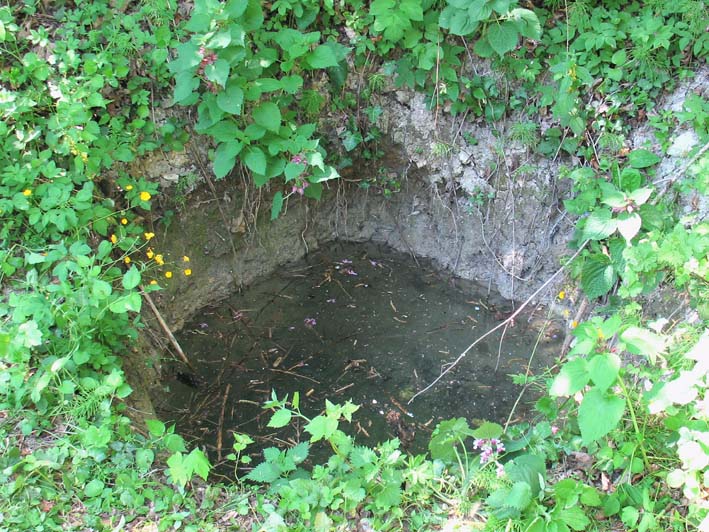
Example of the "hunting pit" filled with water and a lot of fire
salamanders.
Nearby is a brook also with small salamanders.
VIDEO (1.6MB) : releasing a young one into the water
DID YOU KNOW:
* There is a myth tht Grass Snakes like to drink milk, that they can even "milk" a cow, but that is just a myth.
* In Dalmatia (and other places) people leave a hole in their porch and they put milk inside so that they attract Grass Snakes. This method is used as "protection" gainst venomous species, which she chases off.
* Ranges can be 3-120 hectares, in which they travel 10-300 m per day.
* On riverbanks there is often 1 "Grassy" every few meters.
* Diferences:
N.n.persa up and N.n.natrix down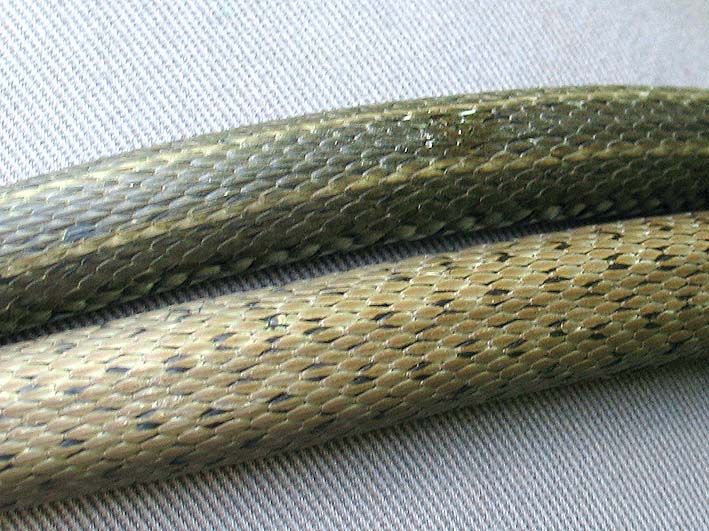
N.n.persa up and N.n.natrix down
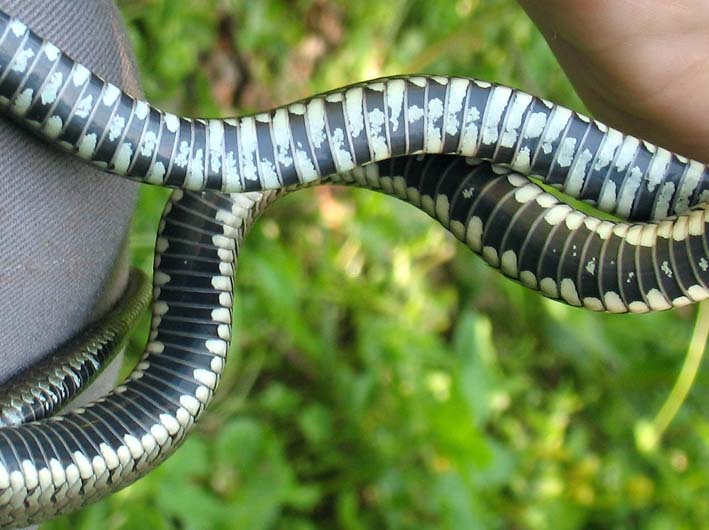
N.n.persa left and N.n.natrix right

N.n.natrix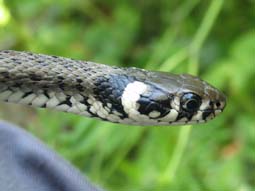
N.n.persa
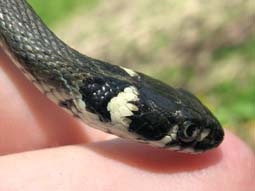
VIDEO
(4.8MB) :
the longest Grass
Snake we have met (137cm)